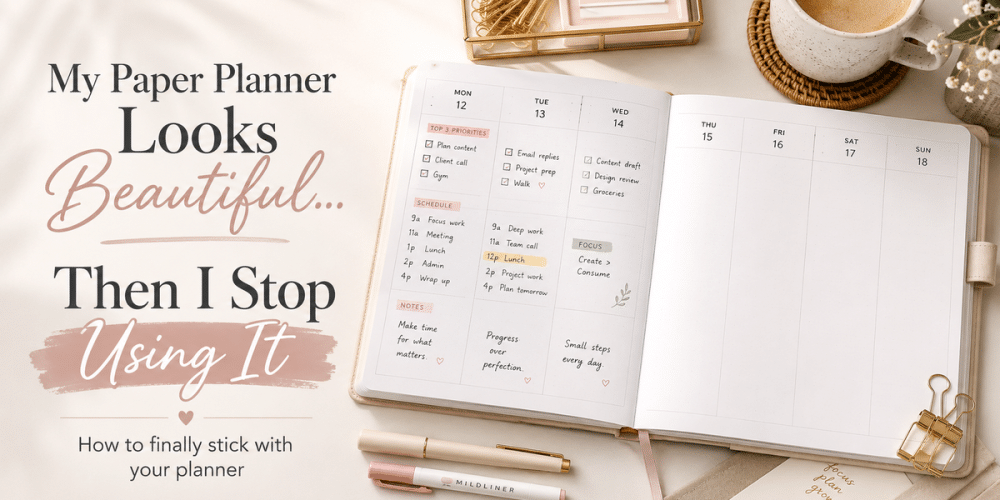
You buy a new paper planner with the best intentions.
The prettiest cover catches your eye, the perfect pens make planning feel exciting, and before long, your appointments are neatly written, your categories are color-coded, and your weekly spread looks beautifully organized.
For three days, you feel completely in control.
Then Tuesday gets busy.
You forget to open your planner in the morning. A few tasks change. You write a reminder on a sticky note instead. By Friday, your planner is sitting closed on the counter—and somehow, opening it now feels like another task you have failed to complete.
If this happens to you, you are not bad at planning.
Your planner system is simply asking too much of you.
The goal is not to create a planner that looks beautiful when life is calm. The goal is to create a planner you can still use when life is busy, messy, unpredictable, and slightly overwhelming.
Here is how to make that happen.
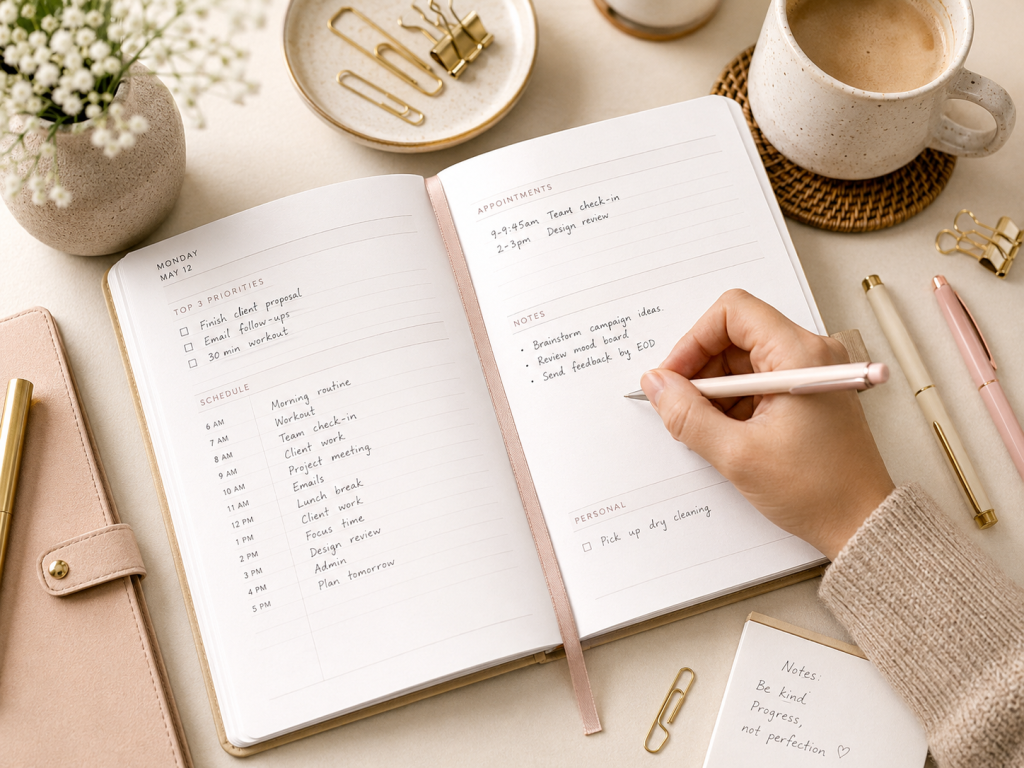
Why You Keep Abandoning Your Planner
Most people believe they stop using their planner because they lack discipline.
That usually is not the real problem.
The real problem is that they created a planning system that only works when they have plenty of time and motivation.
You may be trying to:
- Write down every task
- Use multiple colors and symbols
- Track several habits
- Create perfectly organized daily pages
- Rewrite unfinished tasks each evening
- Make your handwriting and layout look aesthetically pleasing
That system may be enjoyable at first, but it creates too much maintenance.
The more complicated your planner becomes, the more energy it requires to keep using it. Eventually, missing one day feels like falling behind. Missing three days makes the planner feel almost impossible to restart.
A planner should reduce mental clutter—not create another standard you have to live up to.
Stop Trying to Be a “Planner Person”
You do not need to become someone who spends 30 minutes decorating and organizing a planner every morning.
You simply need a planner that helps you answer three questions:
- What must happen today?
- What would be helpful to accomplish?
- What do I need to remember for later?
That is it.
Your planner does not need to document every hour of your life. It does not need to hold every idea, goal, grocery item, habit, appointment, and long-term project.
It needs to help you make better decisions about your time.
Use the Minimum Viable Planner Method
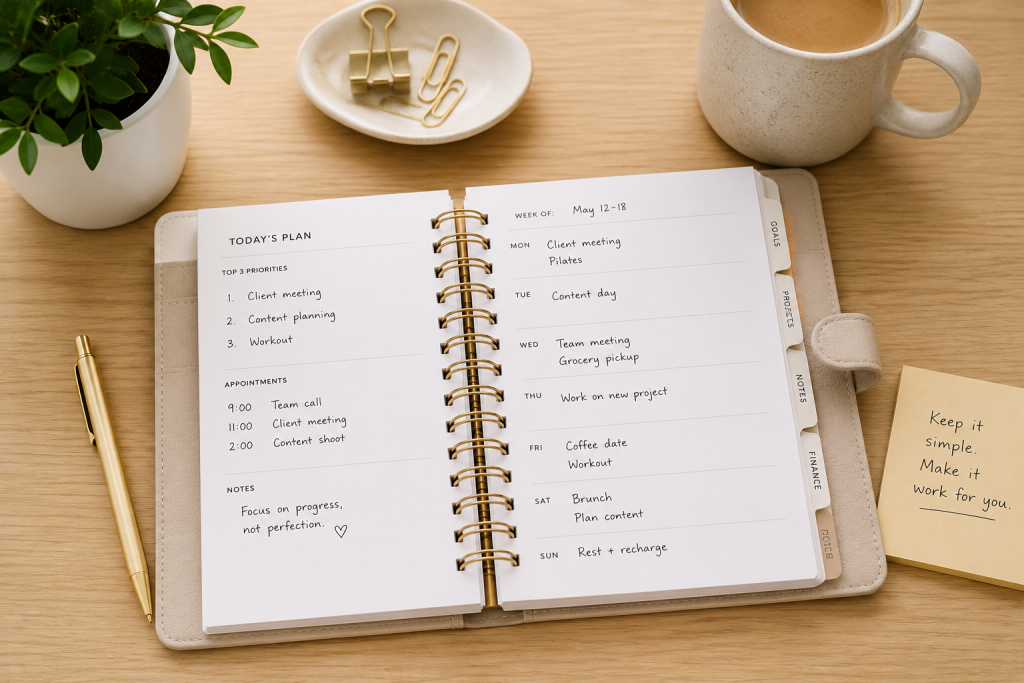
The solution is to create a Minimum Viable Planner—the simplest version of your planning system that is still useful.
Instead of filling every section of the page, use only three areas.
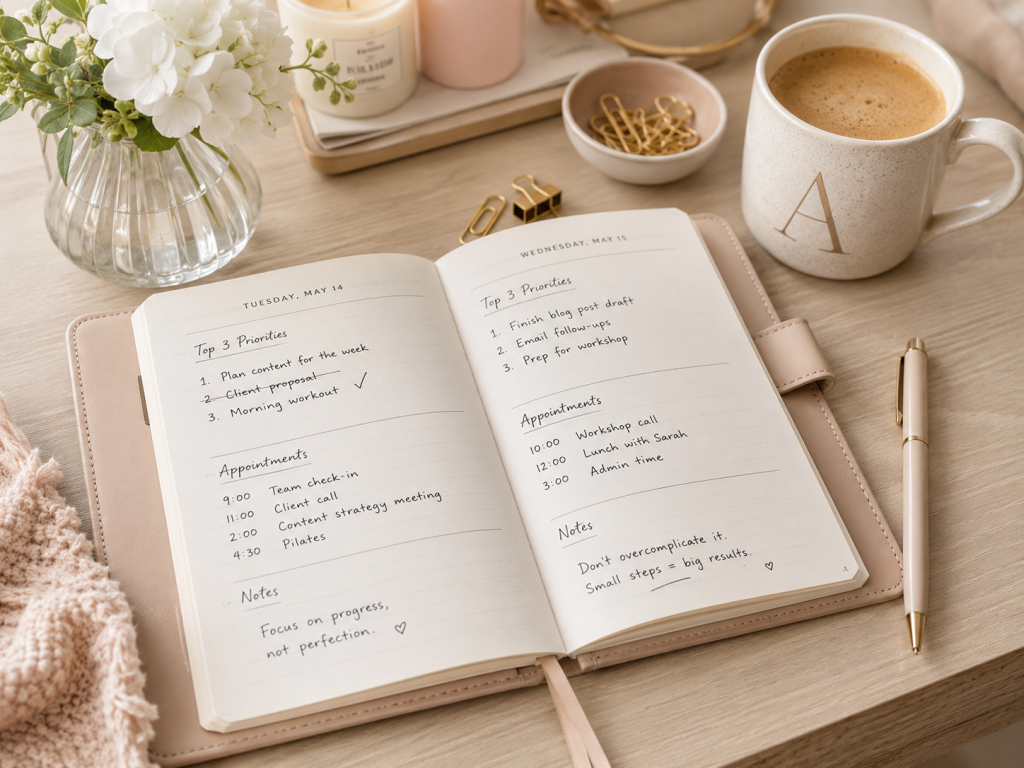
1. Today’s Top Three
Choose the three most important things that need your attention.
Not ten.
Not an overwhelming master list.
Just three.
Your Top Three may include a work priority, a household responsibility, and one personal task.
For example:
- Submit the monthly report
- Schedule the dentist appointments
- Order groceries
These are the tasks that will make the day feel successful even if nothing else gets completed.
2. Appointments and Time Commitments
Write down anything that must happen at a specific time.
This includes meetings, appointments, school activities, deadlines, pickups, and events.
Your planner should make it easy to see where your time is already committed before you add more tasks.
3. The “Not Today” List
This is where you place tasks you want to remember but do not need to complete today.
This section is important because many people overload their daily planner with every task currently on their mind. Then they look at the page, feel behind before the day has even started, and avoid the planner altogether.
Writing something down does not mean it must become today’s responsibility.
Make Your Planner Easier to Restart
The best planning system is not the one you never abandon.
It is the one you can easily return to.
You will miss days. You will have busy weeks. There will be mornings when you forget to open your planner.
That does not mean the system has failed.
Leave the missed pages blank. Skip rewriting every unfinished task, and resist the urge to catch up on everything at once.
Turn to the next available page and begin again.
Write today’s date.
Choose your Top Three.
Add your appointments.
Continue from there.
Your planner is a tool, not a permanent record of how productive you have been.
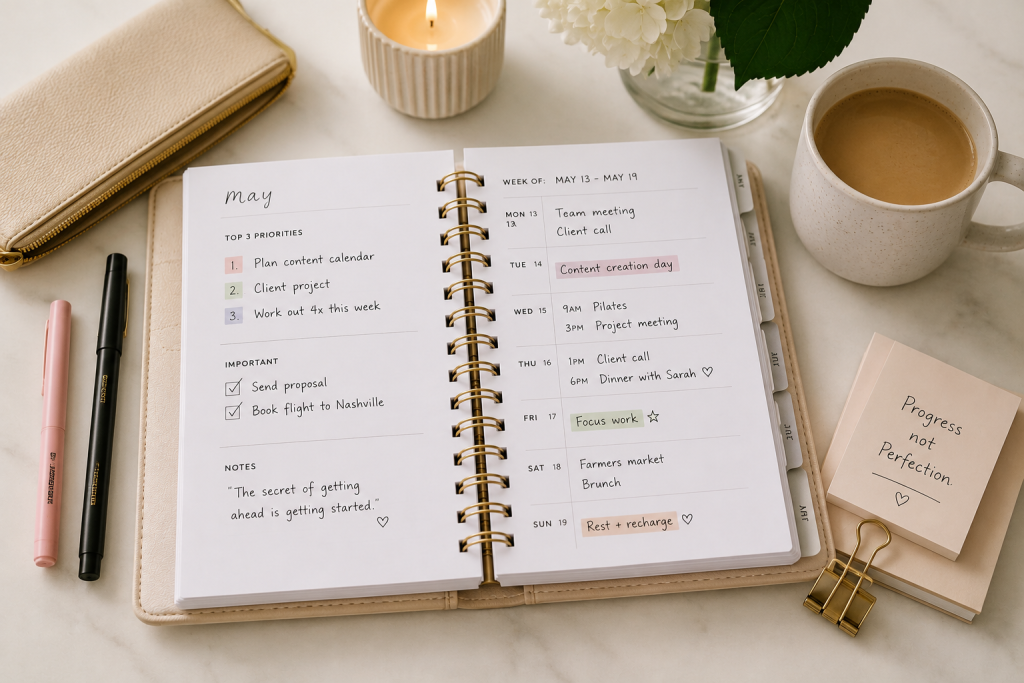
Create a Two-Minute Planner Routine
Your planner habit should be small enough to complete even on a difficult day.
Try this two-minute routine each morning:
First minute: Check your calendar and write down any scheduled commitments.
Second minute: Choose your Top Three priorities.
That is enough to begin your day with direction.
You can add more details when you have time, but the basic planning habit should never require more than a few minutes.
Consistency comes from making a habit easy to repeat—not from making it impressive.
Keep Your Planner Where You Make Decisions
Your planner will not help you if it is hidden in a drawer, buried in a bag, or sitting in a room you rarely use.
Keep it where you naturally make daily decisions.
That might be:
- Beside your laptop
- On the kitchen counter
- Next to the coffee maker
- On your nightstand
- Inside the bag you take to work
Pair opening your planner with something you already do every day.
For example:
- Open it while drinking your morning coffee
- Review it after turning on your computer
- Check it before leaving the house
- Look at it while packing lunches
- Review tomorrow’s page before plugging in your phone at night
You do not need more motivation. You need a visible cue.
Stop Saving the Planner for Your “Ideal Life”
Sometimes people avoid writing in a beautiful planner because they do not want to make mistakes.
Crossing things out can feel like ruining the page. Messy handwriting may make the planner seem less appealing, and once the layout no longer looks polished, it is easy to lose motivation.
But a planner is supposed to look used.
Plans change. Meetings move. Children get sick. Priorities shift. Tasks take longer than expected.
Crossed-out items and rewritten appointments are not signs that you are disorganized. They are evidence that you are actively managing a real life.
Use the nice planner.
Use the good pen.
Write imperfectly.
The purpose of the page is to support you—not to impress anyone.
Plan for Your Actual Energy
Another reason planner systems fail is that people plan according to their available hours instead of their available energy.
You may technically have two free hours after work, but that does not mean those two hours can hold six complicated tasks.
Plan according to what you are realistically capable of doing during that part of the day.
Place mentally demanding tasks during your strongest hours. Save easy administrative tasks for lower-energy times.
Instead of writing:
- Clean the house
Write:
- Clear the kitchen counters
- Start one load of laundry
- Vacuum the living room
Specific tasks are easier to begin, easier to complete, and more satisfying to check off.
Use One Capture Place for New Tasks
Many planning systems become confusing because tasks are scattered across too many locations.
You may have reminders in your phone, sticky notes on your desk, notes in your email, screenshots, text messages to yourself, and lists inside your planner.
Choose one place to capture new tasks during the day.
This could be a notes page in your planner or a simple digital inbox on your phone.
Once a day, quickly review that list and decide:
- Does this need to be scheduled?
- Does this belong on a future list?
- Can it be deleted?
- Can someone else handle it?
- Does it truly need to be done?
Your planner should contain decisions—not every passing thought.
Try the Five-Day Planner Reset
You do not need to commit to using your planner perfectly for the rest of the year.
Commit to five days.
For the next five mornings:
- Open your planner.
- Write the date.
- Add your appointments.
- Choose your Top Three.
- Close the planner and begin.
Decorate it only if that genuinely helps you enjoy the process.
Leave unused sections blank without feeling guilty.
Skip the pressure to track every habit.
Focus on building a routine that feels realistic, not perfect.
At the end of five days, ask yourself:
- Did the planner help me know what mattered?
- Did it reduce the number of things I had to remember?
- Was the system easy enough to repeat?
- Which parts did I actually use?
Keep the helpful parts. Remove everything else.
Your Planner Does Not Need to Be Beautiful Every Day
A beautiful planner may inspire you to begin.
A simple planner will help you continue.
The goal is not to create a perfect page. The goal is to create a life that feels easier to manage.
Your planner is working when it helps you remember an appointment, make a decision, complete an important task, or stop carrying your entire to-do list in your head.
Some days, your planner may contain neat handwriting, color-coded sections, and carefully organized priorities.
Other days, it may contain three hurried notes and a coffee stain.
Both pages count.
You do not need to use your planner perfectly.
You only need to make it easy enough to open again tomorrow.
The Simple Planner Formula to Remember
When your planner starts feeling overwhelming, return to this formula:
Appointments + Top Three + Not Today
That is enough.
You can always add more when your schedule, energy, and interest allow. But this simple structure will keep your planner useful long after the excitement of the first three days has faded.
Because the best planner is not the prettiest one.
It is the one that still works on a busy Wednesday.



Leave a Reply